

“It Has to Be F*ing Cool”: Meet the Man Behind the Blacksheep ONE

Updated: Aug 15

Most motorcycle manufacturers start in roughly the same place. A proven frame. A supplier catalogue. A motor. Suspension. Brakes. Electronics. Years of experience refining what already exists. But that's not how the Blacksheep ONE was built.
The first time I stood in front of it, it didn't just look different. It looked like someone had questioned almost everything we'd come to accept about how a motorcycle should be built.
The motor wasn't hidden away like an industrial component. It dominated the bike. There were almost no visible cables, and every machined surface looked like it was designed to be noticed.

Over the following months, I kept coming back to the same question: Why would anyone choose to redesign almost every major component of a motorcycle from scratch when even the world's biggest manufacturers buy so much of their technology from specialist suppliers?
So I put that question to Blacksheep Power founder, engineer and CEO Mark Gilligan when we met at the Malle Mile festival. And pretty quickly, it became clear this wasn't really about electric motorbikes. It was about engineering.
For our write-up of the Blacksheep ONE, visit: Blacksheep One: Function First, Rules Nowhere in Sight
The Engineer, Not the Motorcycle Founder
The answer starts long before Blacksheep Power, with an engineer who didn't begin his career in motorcycles at all.
"My first passion when I decided to study engineering was vehicles. Aeroplanes and motorbikes and cars. My first career was actually in Formula One."
But Formula One wasn't where he stayed.
"I was a very impatient, arrogant young lad, and I wanted to be the boss of something soon. I just felt that the automotive industry was very, very conservative, and it felt very difficult to have any kind of level of change in it."

Instead, Mark spent the next three decades building companies in life sciences, nanotechnology and precision engineering. Not exactly the usual route into building motorcycles. But it explains a lot about the ONE. Precision runs through pretty much everything Mark does, and that mindset has found its way into every part of the bike.
"Everything I've ever done in my working life before has been the world-leading thing. It's something that's never been done before."
Why Start Again?
Blacksheep Power didn't begin with the ONE. It started with a bike that almost everyone knows. In 2018, Mark and his teenage son started an electric conversion on a Honda Cub, not as a business idea, just because it sounded like fun.
"My son... was probably about 13 at the time. We made an electric Honda Cub. We took the Cub and we chopped it up and we made it look like a BMX but put an electric drivetrain in it."
"People kept being surprised by how quickly it sort of whizzed off and asking whether they could buy one somewhere."
And that's where Blacksheep Power started. If an electric drivetrain could work across one old bike, why couldn't it work across plenty of others? And where there are old motorcycles, there's an opportunity.
"I thought, well, if you made an electric powertrain that fits on those engine mount points... perhaps we could make a conversion kit."

Around the same time, another opportunity appeared... Vietnam. His wider engineering businesses were already operating internationally, and Vietnam's motorcycle culture immediately caught his attention.
It looked like the perfect place to build the electric conversion business. By 2019, he'd assembled a team of Vietnamese engineers. By early 2020, they were approaching production.
Then COVID changed everything. While much of the world shut down, Mark's wider science businesses expanded rapidly, helping solve supply chain and life science problems during the pandemic. Eventually, he sold one of those companies.
Selling that business gave Blacksheep Power something few new motorcycle ventures have: money, time, the freedom to do things properly, and an engineering team ready to get stuck in.
Instead of asking how to build a better conversion kit, the question became: why build one at all?
"I didn't want to just make any old thing where you buy the motor from that supplier and the controller from that supplier and just put some wheels and handlebars together."
"If I'm going to make a motorbike, it has to be, on some axis, something nobody's ever done before... and it has to be, in my mind, fucking cool."
Building the Blacksheep ONE: Integration as an Obsession
Walk around the Blacksheep ONE and something feels unusual before you've even started looking at the numbers. Everything is designed to work together, starting with the bit that really matters: the motor.
"Our central lump, which is the motor... it is the central spine and frame of the bike all at once. We don't have a separate motor you can unscrew and take away."

That single decision changes almost everything. How the bike looks. How it's held together. What it's made from. And, most importantly, how you actually build the thing. The headstock is carried by a compact aluminium structure, while the swingarm, seat and suspension all connect back into the same integrated motor assembly.
The result isn't just a cleaner-looking motorcycle. It's a machine that can apparently be built in about an hour.
"If we've got the main lumps there, it's about an hour to build the entire motorbike."
Perfect First. Cheap Later
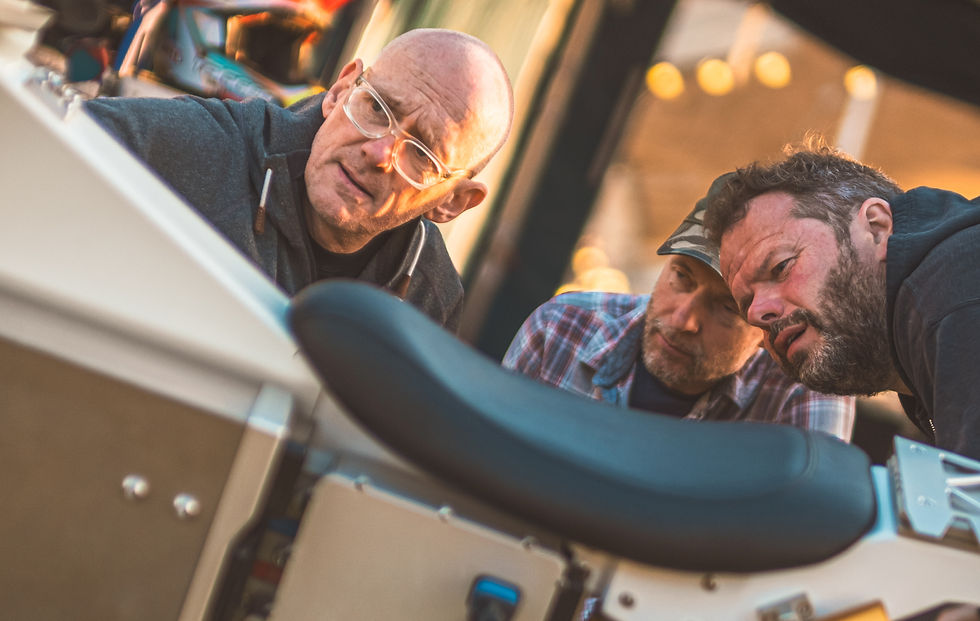
Most OEMs begin with a target price. Everything else works backwards from there.
For Blacksheep Power, the price came later. First came the motorcycle. Build it properly, then work out where you can save money. That doesn't mean money doesn't matter. It means it doesn't get to dictate the bike before the bike is finished.
"I wanted to make something simplistically fucking amazing and didn't worry about cost, because I didn't want to compromise quality... it's not perfect to everybody's taste, but at an engineering level, it's perfect."
It's a different way of doing things, but the pursuit of perfection comes with compromises.
"It's probably heavier than it needs to be. And once you've got it perfect, you can work out where can you make it cheaper. But you need to finish first to get something perfect in the beginning."
It's the opposite of how most motorcycles are developed. Build the best solution first. Optimise it later.
Question Everything
"Everything is basically very, very precise. Really, really precise. And cables of all kinds are very, very imprecise."
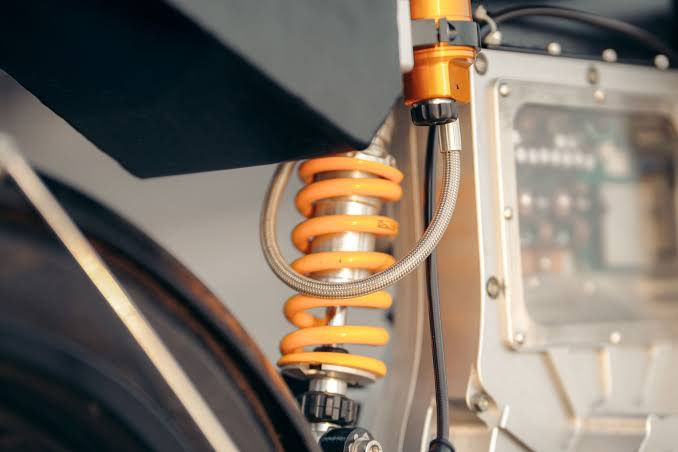
The ONE doesn't rely on conventional wiring looms and dozens of individual cables and connectors. Instead, Blacksheep Power uses the concept of printed circuit boards (PCBs) to integrate the electrical architecture into the motorcycle.
The PCB concept wasn't invented specifically for the Blacksheep ONE. The technology already exists in low-power applications, and we've all seen circuit boards in everyday household devices. The trick was making the same basic idea work at high voltage, motorcycle scale.
That thinking eventually produced one of the most distinctive parts of the Blacksheep ONE: the Billet Flux motor. It's a completely different way of building a motor, designed around the realities of making small numbers while handling serious current and, importantly, leaving fewer things to go wrong.
"If I'm gonna make a motorbike, it has to be on some axis something nobody's ever done before."

Large-scale manufacturers can throw industrial machinery at the problem. Small manufacturers don't have that luxury. If you're building your own motor, you can't just buy a massive production line and crack on. A lot of it ends up being done by hand. And winding copper wire by hand is slow, fiddly and inconsistent.
So Blacksheep Power went another way. It machines precision copper billets on CNC machines, then builds them into the motor. On paper, it sounds more complicated. In practice, the thinking is surprisingly simple.
"Using CNC makes every one identical and perfect... much more perfect than almost any other manufacturing technique."

If you're building thousands of bikes, this probably makes no bloody sense. But the ONE is produced in batches of 50, so suddenly it starts to make a lot more sense. The same thinking extends beyond the motor itself. Even the electrical connections throughout the bike move away from traditional cabling wherever possible and instead use more copper billets and bus-Bar style power distribution.
No Motorcycle Rulebook
"When engineers from Triumph or Norton or Honda have seen what we've done, they're absolutely shocked. They don't do that level of work themselves because they buy this piece from that supplier or this piece from that supplier."
Large manufacturers are designing motorcycles for thousands of units. The ONE will be built in batches measured in tens, not tens of thousands. That completely changes the engineering decisions available.
"If you're not going to make thousands... then we can use the best quality manufacturing process possible."
That means decades of accepted motorcycle thinking can be thrown back on the table. It also allows engineering decisions that don't make commercial sense for a global OEM but make perfect sense when you're building something entirely your own.
Fifty Bikes. And That's the Point.
For all the ambition packed into the Blacksheep ONE, the numbers are tiny.
"We're not going to make thousands, we're going to make tens, maybe hundreds, but tens is our primary focus, then we can use the best quality manufacturing process possible. And we're going to accept that that means it's going to be expensive."
They don't need a factory churning out thousands of identical bikes. They can build the thing properly, use processes that would be too expensive at scale, and worry about the numbers afterwards. It also means the business doesn't need to sell hundreds of motorcycles just to keep the lights on.
"We could probably sell about four or five bikes a year and we'd be profitable."
But there is another problem to solve first: trust. Nobody wants to hand over £35,000 to a motorcycle company they've never heard of.
"Finding them and working out who they are and making them trust in the brand is all actually about time."
It means people need to see the bike, see customers riding them, and see Blacksheep Power still standing there the next time they come across it. If you're deliberately building motorcycles by the dozen, patience is probably more useful than scale.
"It might take some years... we've appeared more times in more places, and more people have started to realise, 'Oh, I've seen that before,' and start to trust that this is something that is here to stay."
It Doesn't Have to Survive on Motorcycles
There's another part of the Blacksheep Power model that might be even more important. The company isn't dependent on motorcycle sales to keep its engineering operation alive.
The same teams developing the ONE also work across Mark's other science businesses. Unlike a typical startup, they're not burning through investment while waiting for motorcycle sales to arrive.
"The company's not gonna go bust, because I don't need the company to be successful quickly, because I've got all the other businesses."
"The engineers and scientists there, they're not gonna get fired just because we're not gonna sell any motorbikes. They'll still be there working on the other things."
That's pretty much the opposite of the usual electric motorcycle startup story. The motorcycle can develop at its own pace, leaving the Blacksheep ONE to be what it was designed to be.
Vietnam to Britain
The Blacksheep ONE is British in character, as is Mark, but its development and manufacturing span two countries.
"It's been designed between teams in England and Vietnam. But the components are all manufactured in Vietnam, and the final assembly is all in England."
"Every component that's made to our design, which is coming up towards 1,000 components, so that's a lot of bits."
There's the irony: nearly 1,000 parts make up a motorcycle that looks like it barely has any parts at all.
The trick isn't having fewer parts. It's making nearly 1,000 parts behave like one bike.
The Buyout That Nearly Changed Everything
Before the Blacksheep ONE became the sole focus, there was serious consideration of combining the electric project with two of Britain's well-known motorcycle names: CCM and another well-known volume builder. The story could have taken a very different direction.
"I almost bought them together, and put them with the Black Sheep stuff to end up creating basically a really cool motorbike, engines and electric stuff together."
Mark's obsession isn't really with electric propulsion. It's with making cool motorbikes.
"Because the main point about it is I don't really care whether something's electric or whether it's got an engine. I just like cool things, basically."

The CCM and Langen plan ultimately didn't happen, but it tells us something important about what drives the project. There's no religious divide between petrol and electric. There is no belief that one type of powertrain automatically makes a motorcycle interesting. A good bike has to earn that description.
And perhaps that's why the Blacksheep ONE feels so different. It wasn't conceived as an environmental product that happened to have two wheels.

It wasn't designed to convince petrolheads to give up their bikes. It started with something much simpler: the idea of making something genuinely cool.
Which leaves us with a much bigger point than whether electric motorcycles can replace petrol. What if they didn't have to?
Ride safe, folks.
Don't miss the next story. Subscribe to our newsletter. It's free, no spam, just an email on Friday.
Want more from BCB? Become a member for exclusive offers, community benefits and more.


