

Study at University. Build Electric Motorcycles. That's Electric Superbike Twente


Forget the lecture hall. Forget the thesis. You can spend a year designing, building and testing a real racing motorcycle, then take it to a circuit and race it against teams from around the world. All while studying a course completely unrelated to engineering.
That's exactly what a group of students at the University of Twente in the Netherlands are doing. Electric Superbike Twente is a student project with a simple ambition: build electric motorcycles that can race and prove that electric can be fast, exciting and worth taking seriously.

This year's team includes Jelle van den Brink, a Business and IT student who has spent the year leading the project's powertrain team.
When we spoke to Jelle, Electric Superbike Twente's latest motorcycle was still being built. Since then, we've finally got to see what all that work produced. The Nexus-TR.
At Twente, you don't have to be an electrical engineer to build an electric motorcycle. You just have to want to build one.
Meet Jelle

Jelle wasn't a lifelong motorcycle obsessive when he joined Electric Superbike Twente. He's studying Business and IT, and this year he's taken responsibility for the bike's powertrain while also getting involved with programming, partners, sponsorship and communications.
And that's exactly what this team needs. Building a racing motorcycle takes more than engineers.
"We need every type of student. Not only mechanical or electrical engineers, we also desperately need business students or communication science students, because a team manager, for example, doesn't do anything technical. It's managing a team."
That makes a big difference when the thing you're building isn't a university model sitting on a desk. It's a race bike. Jelle joined because he wanted to do something alongside his studies, rather than simply spend another year in lectures.
"I just thought the project was really cool. I really wanted to also do something next to my studies. I think that was also a big factor. The experiences you get in such a year as this are completely different from just doing some studying."
This Isn't a University Assignment

Electric Superbike Twente isn't a formal university course. It's a student project that sits alongside normal studies, and pretty much anyone can get involved.
And then, just when they've spent a year figuring out how to build an electric race bike, they leave. Every September, the entire team is replaced.
It sounds like a recipe for chaos, but the handover is one of the most important parts of the project. The incoming team goes through the previous team's work, talks to alumni and tries to understand why things were done the way they were before deciding what to change.
"There is quite a heavy handover, but whenever you start, you're just thrown into the deep end. You have to read a lot of information, see what people have done, message old people like, 'Hey, why is it like this? Why is it like that?' So it's a bit of both. But whatever the next team is doing, they can also decide themselves."
There's no brief. You're inheriting a motorcycle, a pile of engineering decisions and everything the previous team learned the hard way. Then you have to decide what you're going to do with it.
From Building Fast Bikes to Racing Them

About two years ago, Electric Superbike Twente decided it was time for a new challenge and entered MotoStudent.
The MotoStudent project has been running since 2017 and has produced several generations of electric race bikes. Earlier machines were proper electric superbikes, including the Vector-ST, which was capable of around 300 km/h and could do 0-100 km/h in less than three seconds.
MotoStudent brings university teams together at MotorLand Aragón in Spain, where they design, build and race motorcycles under a tightly controlled set of regulations designed to level the playing field.

That changed the engineering challenge for the team at Electric Superbike Twente. The bikes they'd built before had considerably more freedom.
As a result, the students building the new bike are deliberately making a motorcycle that isn't as powerful or as fast as some of the machines built before it. The MotoStudent rules cap the electrical system at 126 volts, while the electric motor is supplied to the teams by the organisation and can't be opened up and modified.

For a team that previously worked with much higher-voltage systems, that creates an interesting problem. If you can't push the voltage up, the current has to go up to get the power. At peak, Jelle says they're seeing around 400 to 500 amps. That's a lot of current to push through a motorcycle.
It means the battery cells, bus bars, connections, cables, cooling and electrical protection all become critical. You're not just designing a battery that stores enough energy. You're designing an electrical system capable of delivering enormous current without turning itself into a very expensive heater.
“We don't hate the regulation — saying that is a bit too much — but we definitely think it's a pity that we're limited in that way.”
For the students, it also becomes another engineering lesson: how do you make the best race bike possible when you can't simply throw more voltage and power at the problem?
So What Do the Students Actually Build?
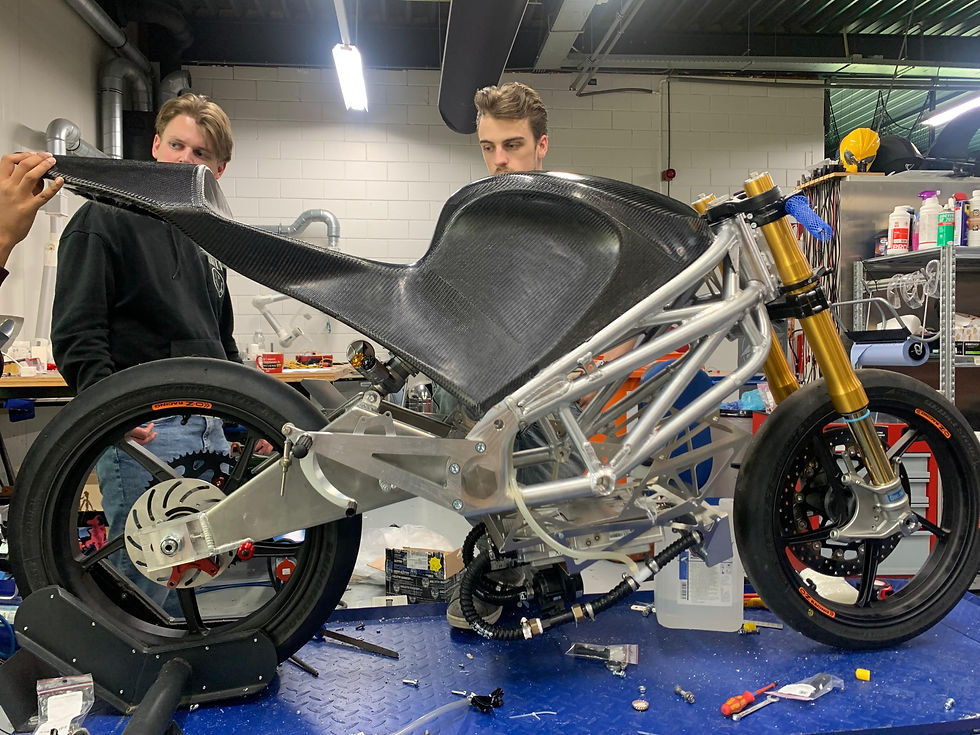
Quite a lot. Almost everything around that supplied motor is designed by the students.
The battery is theirs to design, apart from the cells themselves. They build the pack, battery management system, electronics and safety systems around those cells. This year's bike has moved from pouch cells to cylindrical cells, with the team choosing Reliance RS50 cells for their ability to deliver high current.

The pack itself is split into two identical modules, making it easier to work on and replace if one develops a problem. There's also an air channel through the middle of the pack, with airflow coming through the sides to help pull heat away from the cells.
And then there's the weight. The previous MotoStudent bike was heavy, and this team wants to take around 25 kg out of the battery pack alone, with a target bike weight of roughly 145-150 kg for the new NEXUS-TR.
It's not just about energy density. It's about building something a team of students can actually get inside, understand and repair when something goes wrong.
Learning to Build Things You Can't Learn From a Book

That philosophy runs through the rest of the motorcycle. The students design the frame and swingarm, but they don't pretend they can do everything themselves.
They source the material, cut it, build the welding jig and prepare the components. Then the actual welding is handed to a specialist.
"We are all university students. We are not professional welders."

They're not trying to prove that a bunch of students can magically do every job themselves. They're learning where their own skills end, where they need specialist help and, crucially, how to make the engineering decisions that get the whole thing built.
The team has designed and built a carbon fibre sub-frame. Their custom structure combines the tank and tail section into one piece. The students 3D-printed the form, made a negative mould from it and then laid up the carbon themselves.
Sometimes the only real way to learn is to have a go. You can learn the theory in a classroom, but learning how to actually make the thing is different. That's what Twente offers its students.
You make something. You find out why it doesn't work. You fix it. Then you hand what you've learned to the next team.
The Bike Has to Survive the Race

Eventually, all that clever engineering has to survive someone trying to ride it as fast as possible around a racetrack.
Electric Superbike Twente uses Wouter van Wensveen as its test rider, an external rider with motorcycle and racing experience. Jelle makes it clear that the team isn't building a bike for a laboratory test. It's building one for wheel-to-wheel racing.
Their first MotoStudent campaign in 2025 gave them something to build on. Electric Superbike Twente won Rookie of the Year and finished 13th overall.
“Next year, our ambitious goal is to finish in the top five.”

That's a big ask for a team whose entire membership will change before then. The target belongs partly to the next team, not just this one. They're trying to leave the next team with a better starting point than the one they inherited.
Since we spoke to Jelle, the motorcycle has gone from a bike still being built in the workshop to a finished race bike. Electric Superbike Twente has now unveiled the Nexus-TR. It weighs 150 kg, produces 48 kW and uses a 9 kWh battery. That's roughly the machine he was describing: lighter, more modular and built around the lessons from the team's first MotoStudent bike.
Nexus-TR: The Numbers
Power: 48 kW
Battery: 9 kWh lithium-ion
Weight: 150 kg
Top speed: 200 km/h
Torque: 100 Nm motor / 500 Nm at the rear wheel
Battery configuration: 30s17p
Frame: Aluminium 7020 T6
Swingarm: Aluminium 7020 T6
Subframe: Carbon fibre
Front suspension: Öhlins FGRT
Rear suspension: Öhlins TTX RT
The University Project That Doesn't Really End

A new group of students takes over every September. But that doesn't mean the previous team disappears.
Some former Electric Superbike Twente students have gone on to work in the electric motorcycle industry, including at Radian, the Dutch company developing its own electric motorcycles.
“Every year there are one or two people from our student team who do their internship, for example, at Radian. Everyone who works there has been a part of Electric Superbike Twente.”

That's how it works at the University of Twente.
The motorcycle gets built, raced and eventually replaced. The students move on. But the knowledge, contacts and experience don't disappear when the bike is wheeled back into the workshop. They go with the people who built it.
The BCB Take

There's a lot of talk about what the electric motorcycle industry needs next. More range. More power. Better batteries. Faster charging. Cheaper bikes.
All of that matters. But there's another thing the industry needs: people who know how to build the bloody things.
They're making batteries, designing electronics, building chassis components, solving cooling problems, dealing with suppliers and then putting the finished machine on a racetrack.

Sure, the bikes will get faster. The batteries will get better. The technology will change. But the people learning how to make all of it work are arguably just as important.
If projects like this keep putting genuinely hands-on people into the electric motorcycle world, then then university projects like this are the lifeblood of the industry. What
“This year has really ignited a bit of a flame in this world. I really like what I'm doing, and I'm looking at doing something like this after my studies finish. It has really opened up a new perspective and a new interest for me.”
Ride safe, folks.
Tired of scrolling? Subscribe to our newsletter. It's free, no spam, just an email on Friday.
Want more from BCB? Become a member.


