

Damon Motorcycles: A Design Odyssey


What can a motorcycle redesigned five times teach us about process discipline?
The history of electric motorcycle startups reads like Russian literature. There are larger than life characters, princes who dominate countless working peasants, all of whom are ground down until eventually they lay down and die. There is no catharsis. No Disney happy ending.
My late mother adored Russian literature, but despite my best efforts I could not get into it. Real life is hard enough without spending my leisure time reading and weeping over what could have been. Sadly for me, most of my work at Damon Motorcycles was spent toiling for nothing, and similarly ended in grief.
What follows is a design story. What I will outline is the history of the Damon HyperSport as a motorcycle, not Damon as a business. This article is not a tell-all about the inner workings of the company, which is not my story to tell, and to be honest, is not as interesting or scandalous as most people think.
This is a story about how the near-total lack of process discipline in vehicle design, writ large, from finding product-market fit to basic reporting structures, contributed to wasted effort, burned-out people, and ultimately the failure to produce a sellable motorcycle to waiting customers in a reasonable amount of time and with a reasonable amount of money.
It is also my personal design story, about my desire to make the most consequential motorcycle design of my career, and how close I got to doing that.
For more Damon news, visit our Damon Motorcycles page.
The Superbike Dream

Damon was a Canadian company, birthed by a pair generation X sport motorcycle enthusiasts with tech backgrounds. I will let others parse the journeys of founders Jay Giraud and Dom Kwong. They each brought different talents and characters to the table, and through an enormous amount of resourcefulness and sheer will power, they raised millions of dollars and built a company determined to make an electric superbike fit for the smartphone age. And they were determined to make it in Canada.
As a Canadian who has spent nearly three decades designing and planning strategy for motorcycle companies around the world, the opportunity to join this company was, when presented to me, too good to pass up. I liked Kwong personally, and most of what I saw from the outside was encouraging. I was invited to become head of design in March 2021 with a mandate to build a design studio, hire a team and map out a product catalogue filled with diverse motorcycle models for the next five years. I wasted no time and went to Vancouver to get started.
Damon was located in a restored industrial building in a trendy area of Vancouver, across the street from Aritzia, a Canadian fashion brand, and down the street from upscale bistros. Inside I met dozens of young, extremely talented software and hardware professionals soaked in an atmosphere of optimism. The staff may have been mostly millennials, but the vibe was definitely Gen X: infinitely flexible.
Something wasn’t working? Whatever. We’ll figure it out.
And mostly they did.
The co-founders had strong Gen X energy too. The culture was more X-Games than Tesla, feeling more like an energy drink brand than a high tech mobility startup. It didn’t make sense to me, but thousands of pre-orders suggested the world wanted what Damon was selling, despite superbike sales shrinking in every market in the world. This last fact should have alarmed the leadership, but they were unfazed. We were building a 200 mph, 200 mile range, 200 hp hyperbike.
Design No.1 : The CES HyperSport Proof of Concept

The world first met the HyperSport (HS) at CES in January 2020 (it was shown to the press earlier but CES was the big reveal). The original HS was designed by Alberto Bicego, an architect and industrial designer who was based in the Vancouver area. Giraud told me that the original HS was crafted around a desire for a superbike that had a strong “flow” and a clean appearance that stood out from the very fractal designs of Japanese brands and BMW at the time.
The sketches presented were translated into 3D form by a small group of incredibly talented local industrial designers and CAD technicians, none of whom had any training in automotive design, or compound curve surface development. Bicego provided some guidance but the surface development and detail design was all the in-house team (out of respect I’m leaving names out). They did all this in Solidworks, a very poor digital tool for this type of work, which is why no serious automotive company uses it. There was no Alias, no ISEM Surf or Catia… just three Canadian designers who worked their asses off to translate an ethereal drawing into concrete form.

The first HS was 3D printed in house on machines that were not exactly top shelf, which meant that every surface was sanded down by hand, covered in body filler and sanded down again before going to a paint shop.
None of this was professional automotive standard. And yet, as I spent hours studying the first two HS prototypes late into the night in Vancouver a year later, I came to deeply appreciate the craft and care that those guys put into the design. It certainly had some unresolved areas: the seat was far too high, narrow and short; the tank shape totally lacked ergonomic function; the battery cases an afterthought…
But from three feet away it was a gorgeous thing to behold, in the original yellow, devoid of all the later, gaudy graphics.

The original HS was a concept model. It was built on a Yamaha R1 and had Zero powertrain parts from a Zero motorcycle, plus a smorgasbord of after-market bits, but it gave form to a vision. An electric superbike could be sexy. Thousands of people agreed, and it won a Best in Show award at CES and hundreds of pre-orders.
But it was unproduceable. There was no way the design as presented would be able to house the vast 20+ kWh battery, associated electronics, and a real human occupant and hit the performance promised. For that they needed to go pro.
Design No.2 : A Digital Fantasy
Damon hired a bunch of ex-Alta people in the hopes that this would accelerate development. They also acquired some IP from the bankrupt Mission Motors, and engaged Suter Industries in Switzerland to speed up development and add automotive professionalism to the program. The team quickly ascertained that the only way the HS would ever hope to get the 200 mile range and 200 mph top speed was to have the most aerodynamically efficient sport motorcycle in history.

The Bicego design was, as far as fluid dynamics is concerned, a naked motorcycle. I had the design tested in a virtual wind tunnel and the results were worse than a Yamaha MT-07 which was used a baseline. Bicego was a contractor and not involved anymore, so the Alta people took over, modelling a design that claimed to use “Moto2 principles” to achieve a target 0.27 aerodynamic coefficient of drag with a rider in a prone position. It is important to note that the designer had no experience in Moto2 or motorcycle aerodynamics.
This was pure fantasy.
In my years working with large OEMs, I have had the pleasure of learning a lot about motorcycle aerodynamics from very experienced, very smart people. Getting any motorcycle below 0.3 is difficult but not magic, the tricks and tools required is well known. None of them make particularly beautiful motorcycles to the modern eye.

The most aerodynamic motorcycle in 2021 was the (not so pretty) Aprilia RSW250 with its Cd of 0.31. These machines had large and bulbous fairings, paired with long tails that ran deep below the rider, essentially covering the area around the rear wheel. Superbike style in the 2000’s was the exact opposite: sharp, minimal fairings with almost non-existent tail forms.
Damon spent nearly a year working the digital second generation design between teams in Vancouver, California and Switzerland, advancing the basic layout to a point where major changes were no longer possible, without running a single body drag simulation. I arrived as head of design just after Suter told the company that the body would have to change substantially to meet the lofty aero target.
Design No.3 : A 1985 Solution for a 2021 Problem

I was given a clean sheet and free hand to do anything I wanted, but with serious limitations and very ambitious goals.
1) I had only one designer to help me, and he had just graduated from automotive design college. I could hire away but building the team would have to be fast.
2) The engineering layout and chassis were baked-in, there were virtually no changes I could make in the underpinnings to support design.
3) The design had to be finalized by September, hit the 0.27 Cd., and be recognizably a Damon HS that honoured the original Bicego styling promise. It was March.
This was a nigh on impossible task, but… whatever. We went ahead.
I hired aggressively, finding two brilliant young automotive designers in Italy, while the original CAD techs and industrial design team were folded into my unit. By summer of 2021, the design group had grown to 11, and we transformed the street level of Damon HQ into a wonderful design studio with a dedicated clay room, hard model area and mechanical shop. There was an old piano in the corner, and I brought in a sofa so Damon staff felt welcome to chill and watch the clay model unfold.
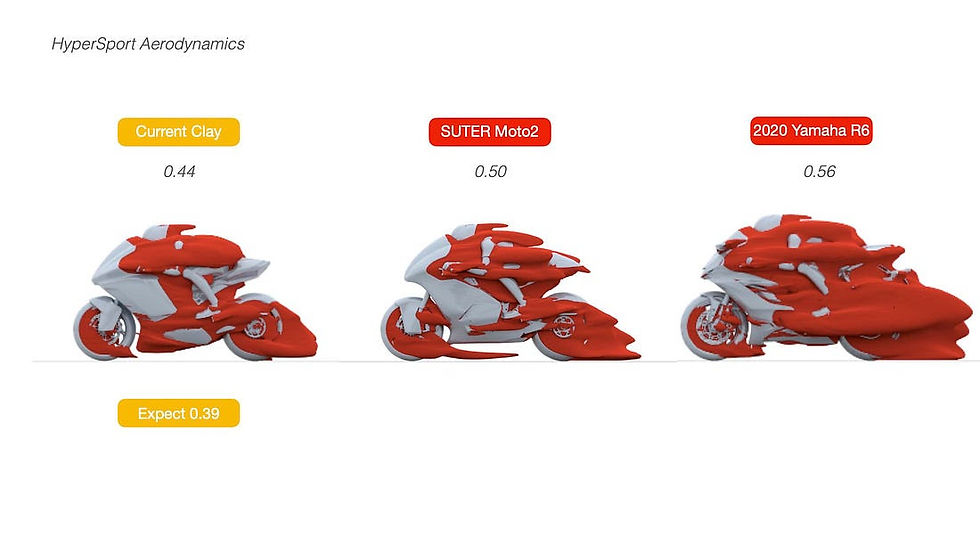
I hired an engineer from Lockheed-Martin Canada to help with the aero development. He and I bought a license to use a European fluid dynamics (aerodynamic) simulation software suite and began building a proper aerodynamic study regime. We modelled all of the existing Damon designs against a Yamaha R6, BMW S1000, and then eventually my clay model.
There was no time for traditional sketch development and presentations. Giraud and Kwong told me to “run”, so we did. It was intense, and it was fun. We regularly stayed late into the night, often being the last ones out of the building in the wee hours. We’d order food, crank up the music and shape the clay as quickly as we could. I’d step out into the hot summer darkness between two and three in the morning and find an Uber back to my AirBnB, clay ground under my nails and into the pores of my hands.

My formula was simple: let’s not reinvent the wheel. The aero gains could only really be made by having the front fairing “eat” the front wheel, cover up the front wheel as much as possible, and close the gap around the rear wheel. To create the illusion of the exact opposite, we would use a layered effect, where the body-coloured panels would be thin and sharp, while the covering bits would be high-gloss black carbon fibre. The trend in car design was to hide girth in SUVs with high gloss black skirting, so the solution was current.
The proportions were further complicated by the giant rear-facing radar unit in the tail, that was a key requirement of the Damon Co-Pilot 360° ADAS system. It made the motorcycle look like it was wearing a full diaper. We asked to move it, and were told emphatically, no. Again, the trick was in panel lines, and using the disadvantage of the rearward bulk to shroud the rear wheel, reducing drag.
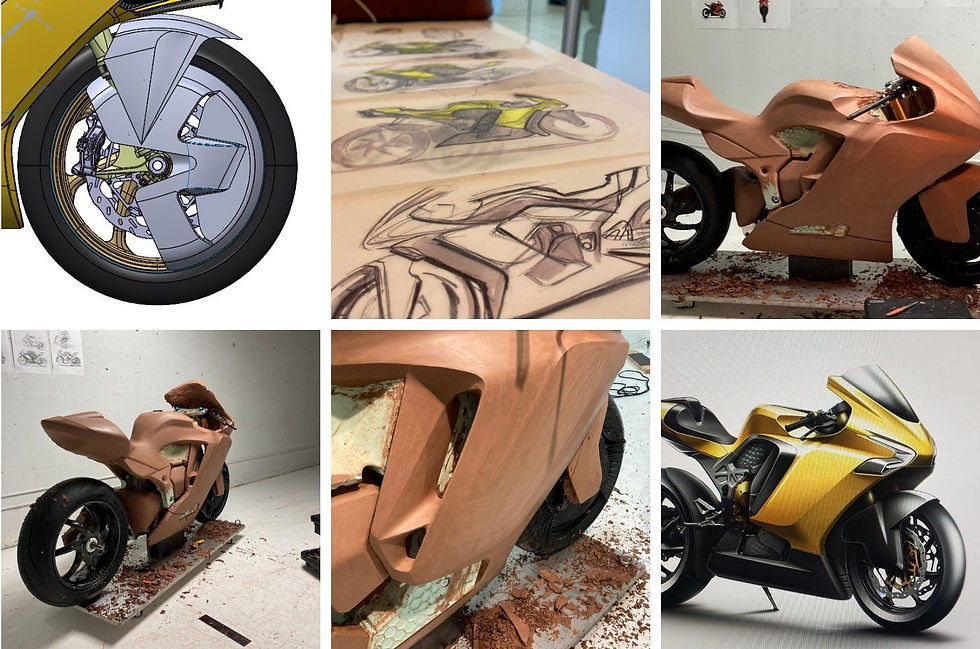
A key styling influence was the 1998 Yamaha OW02 R7, a design that defined the superbike era, gave birth to the tail styling concept that still dominates sport motorcycles today, and was also a favourite of both Damon co-founders.
We scanned the clay, ran it through the simulation software again and again, changing the clay model and refining. By early September, the design was at 0.44 down from 0.52 in spring. This was a stunning improvement. We had bold ideas on how to crush it below .4, and permission to book real tunnel time at the most advanced wind tunnel in Canada for refinement. The aero team was three people, and we were really getting jacked by the work. It looked like we were going to pull off a nearly impossible goal.
Then we got cancelled.
Design No.4 : Design by Committee

I was fired by Giraud after Canadian Thanksgiving, in what may be one of the prouder moments of my career. The backstory is a private matter, but I stood by my principles, and it could be argued that so did he. I joined another startup three weeks later and put Damon out of my mind.
One of the Italian designers I hired was asked to start over. The engineering was being split between Suter and Engines Engineering in Bologna, Italy, whom I had introduced to Damon two years earlier. There was no design leader left at Damon, only the original guy and the two recent graduates, all of whom now took direction from a man with an MBA and whose motorcycle experience was that he had once worked at a Kawasaki dealership in his 20s.
The design process devolved into a pitiful tug of war between hard physical realities, two engineering teams in separate countries, and increasing tension inside Damon’s leadership circle. The young Italian designer and I remained friends, and he occasionally contacted me throughout this period to ask for advice. I was also working at Engines Engineering in Bologna on a Potential Motors vehicle program, so I heard things. None of them were good.

MBA-guy fancied himself an automotive expert. Giraud fancied himself a visionary. Armed with tens of millions of investor dollars, they flew back and forth from Vancouver to Bologna and Switzerland to micromanage it all. There were, by all accounts, many unpleasant moments. The design that emerged was, in my opinion, a generic-looking mid-2020’s sport bike that carried over two key character lines of the original Bicego design, but in a design that was more portly than lithe.
There was, to my knowledge, no aerodynamic testing. The 0.27 Cd target had been dropped entirely, and the 200 mph top speed and 200 mile range were now reframed as “up to” values rather than bankable, real-world specifications.
Design No.5 : All Good Things…

Five designs. Millions of dollars. Years of work.
But this wasn't the end of the story.
Michael's final chapter picks up where this story ends, exploring the final HyperSport design at Damon, how it evolved into the HS/R, why the project ultimately ended where it did, and what lessons future electric motorcycle startups can learn from it.
Michael continues the story on his Substack.
Here's a glimpse of what's next:
Damon was for most of its life an undisciplined mess, polluted from the outset by a move fast/break things, Silicon Valley culture. Mission Motors, Alta, Sondors, Brammo, Cake and so many others all followed the same path to extinction. They all told wonderful stories based on fiction instead of technological and market facts. They brazenly ignored or outright dismissed legacy knowledge from many sources, believing that they knew better, and that legacy knowledge was obsolete.
Ride safe, folks.
Don't miss the next story. Subscribe to our newsletter. Free, no spam, just an email on Fridays.
Want more from BCB? Become a member for exclusive offers, community benefits and more.
Advert


