

Zero's 271-Mile Range Record: We Dive Into the Telemetry


Zero's DS has covered 271 miles (436 km) on a single charge, setting a new Guinness World Records title for the greatest distance travelled by a production electric motorcycle on one charge.
But how exactly did Zero pull it off? There's been plenty of debate in the community, so I sat down with Ryan Biffard to dig into the telemetry. What we found gives us a much clearer picture of how the record was achieved, and leaves one big question hanging: could Zero go even further?
For more Zero Motorcycles news, head to our Zero page.
Meet the Man Behind the Numbers

Ryan Biffard's current title at Zero is Electrical Engineer, Power Train Systems Technical Specialist. He's been with the company for nearly 16 years. He joined as Director of Motor Systems Engineering, helped steer the switch from brushed DC motors to brushless technology in 2012, and designed the motor that arrived on the 2013 model-year bikes. Before Zero, he worked in solar-car racing. In other words, getting the most out of a battery isn't exactly new territory for him.
Ryan tells me the Zero DS that set the Guinness record had been shipped back to Zero's European headquarters, but the telemetry hadn't been fully reviewed. The 12-volt battery had gone flat while the main battery sat at zero state of charge. Zero's system stops topping up the 12-volt battery when the main battery gets too low, and without that 12-volt supply, the team couldn't access the logs.
Now, with me on the other end of a Teams call, Ryan is pulling up the telemetry and working through the full ride. We're looking at the data together for the first time.
The Speed Behind the 271-Mile Run

One of the first things Ryan puts on the screen is motor RPM, a useful clue to how fast the bike was travelling. For much of the ride, the motor was turning at around 2,100 rpm. The bike's 160 km/h (99 mph) top speed corresponds to roughly 6,000 rpm, so the riders were running at about a third of that motor speed.
The team's target was 52 km/h (32 mph) on the road. Their aim was to cover as much distance as possible while keeping energy consumption low, without riding at an unsafe speed for the road conditions.

The reported average speed of around 32 km/h included stops. Ryan estimated that the average while moving was closer to 51 km/h (31.7 mph). The riders stopped several times, including breaks of around 30 minutes, 40 minutes and an hour. He estimates that roughly two hours to two hours and 15 minutes were spent stopped.
The logs also showed the riders slowing for corners and other road conditions. The team had instructed them to prioritise safety rather than maintain a fixed speed at all costs.
How Much Did the Downhill Route Help?
The route's elevation profile has been one of the biggest talking points since the record. The DS started at around 1,800 metres above sea level, climbed a little further, then descended towards the coast. Zero addressed the question on social media after the ride:
"Gravity certainly helped, but the ride wasn't all downhill. Our GPS data indicated that approximately 67% of the route was virtually flat, with downhill sections accounting for around 23% and uphill sections 10%."
The principle is simple. If you're trying to squeeze every possible mile out of a battery, starting high and finishing low is a pretty good place to start.
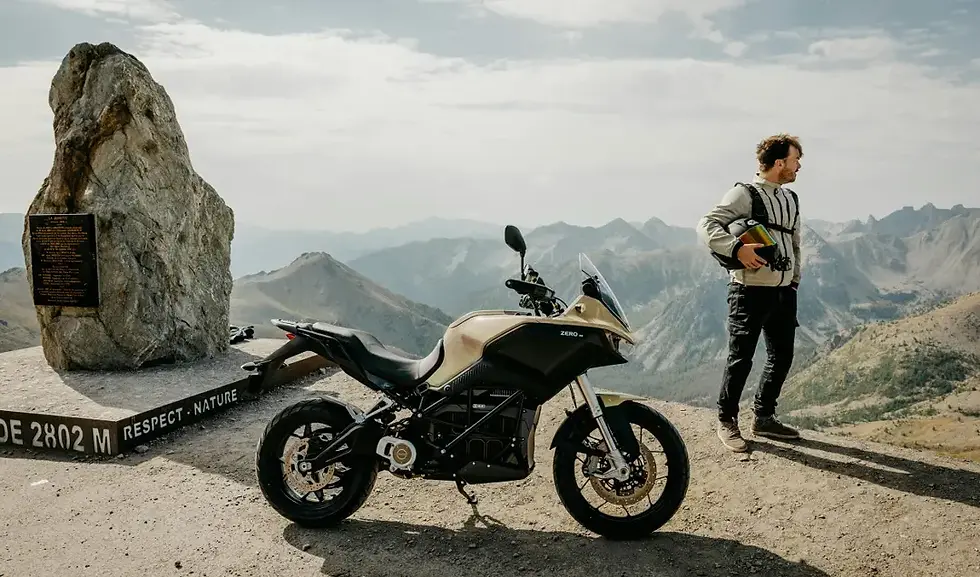
Ryan's calculations put the gravitational potential energy available from a descent of around 2,000 metres at approximately 1.6 kWh. Allowing for the initial climb and the way the route unfolded, he estimated that the overall advantage from starting in the Alps was around 2 kWh.
Two kilowatt-hours is a useful boost, but the main benefit of the descent was concentrated in the early part of the journey. By around 124 miles in, the bike was essentially at sea level, and the remaining distance offered much less assistance from elevation.
The route was chosen to maximise the elevation change while meeting the rules: a production motorcycle riding on normal roads. It was a record attempt, after all, not a Sunday ride.
What About Regenerative Braking?

Regen gets some energy back when you slow down. What it doesn't do is magically return every bit of energy the bike used to get moving in the first place. Anyone who's ridden distance on an electric motorcycle with regen will know what it offers: less reliance on the brakes and some energy recovered along the way.
Ryan estimates the round-trip efficiency at around 80%. Energy is lost as it passes through the motor, controller and battery, both when accelerating and when recovering energy through regeneration.
The team's advice to the riders was to coast where possible, and use regen when they needed to slow down.

If the bike crept above its target speed, easing off and letting it coast could be more efficient than immediately using regen to pull the speed back. Regeneration recovers some of the energy used to get the bike moving, but not all of it. Sometimes, letting the speed drift up slightly is better than repeatedly slowing down and accelerating again.
In practice, regen helped the riders manage their usable energy, but it didn't meaningfully increase the battery's charge. The telemetry showed no increase in state of charge large enough to register even one percentage point. Ryan estimated that the total energy recovered was probably less than 1 kWh, with that energy being used as the ride continued.
What the Temperatures Tell Us

Battery percentage only tells part of the story. Motor, controller and battery temperatures can help an engineer identify whether any component is approaching its limits.
During the record run, the motor and controller temperature traces tracked closely together. The battery remained around 20–22°C, according to the logs, and Ryan saw no indication that the powertrain was being pushed particularly hard.

That makes sense. Nobody was asking the DS to deliver maximum performance here. The challenge was making the available battery energy last for 271 miles, not finding out how much power the motor could produce.
Colder air is also denser, which increases aerodynamic drag. The team ran at night partly for safety and predictability, but the colder conditions were not necessarily an efficiency advantage.
There were some limitations to the data. Ryan had ambient temperature readings, but no wind telemetry. Without reliable wind data, we can't put a precise figure on how much the weather helped or hurt. The telemetry tells us a lot about what the bike did, but there are limits to what it can tell us about why.
Could Zero Go Further?

Ryan reckons the team got the route and speed about right. Could they squeeze out a few more miles? Possibly. A higher starting point, a straighter opening section and a smarter route might all help. The team chose the DS partly because it was slightly lighter and used a smaller motor, although Ryan said Zero's motorcycles have broadly similar aerodynamic and power losses at a given speed.
Wheel covers were another possibility, reducing drag from exposed wheels and spokes. The top of a rotating wheel moves at twice the bike's speed relative to the ground, making wheel design an interesting area for potential gains.

Ryan sees battery development as the biggest opportunity. Packing more usable energy into the same space and weight could push the record further without changing the basic formula. Better batteries could also mean lighter bikes with enough range for most everyday rides, rather than motorcycles that keep getting heavier as their batteries grow. It's a point we've been making at BCB for some time.
Ryan's keen to see someone try to beat Zero's new record, particularly as battery technology continues to improve.
The BCB Take

It's an impressive record, and Zero deserves credit for setting the bar. But it has its limits. It doesn't tell us how far you'd get on the same bike at normal road speeds, on your usual roads or in different weather. And it certainly doesn't prove that the answer to better range is simply to keep fitting bigger batteries.
That's why we wanted to speak to the engineer behind the numbers. Understanding how Zero achieved the record, what helped and where there's room for improvement tells us far more than the headline figure alone.
Now we'd like to see another manufacturer take up the challenge. The bar has been set. Who's next?
Ride safe, folks.
Tired of scrolling? Subscribe to our newsletter. It's free, no spam, just an email on Friday.


