

Can-Am’s Electric Motorcycle Future Just Got Complicated


Three recall notices in two years say a lot about Can-Am electric motorcycles
This one is painful to me, personally. I worked at BRP seventeen years ago, headhunted by them to enhance the motorcycle aspect of the Spyder line-up and to help the then embryonic Can-Am motorcycle program. It took this respected, highly successful Canadian corporate giant fifteen years to get motorcycles across the production line and into dealer showrooms, only to stall out.
For more Market news, visit our Market page.
For more motorcycle industry insights, Join Michael on his Substack.
Late, Expensive, and Low Quality

A total of 577 units are affected by this, the third recall the US government safety agency has issued against Can-Am in under two years. This one says that the ludicrously large touchscreen dashboard can stop working, essentially making the motorcycle illegal and shutting out key functionality that could “… lead to an accident”.
Two earlier NHTSA recalls, both in the launch year of 2025, were more significant. One was for a faulty front brake support, which could lead to “loss of control, significant injury or death”; the second for the main battery, which could allow water inside, risking a fire.
Can-Am’s Sales Have Collapsed
According to NHTSA data, and our own original research into current inventory across the United States, we estimate BRP sold less than 600 units in model years 2025 and 2026 in that critical market. Our research suggests the bikes available at dealers across the country are being offered at discounts averaging around 34%. And we've seen evidence that some dealers are slashing prices by almost half.
This was avoidable, and an entirely self-inflicted wound. With the big investments BRP evidently made into powertrain (it is all proprietary, developed in-house by ROTAX and produced in Quebec and Mexico), plus moulds, tooling and R&D, it is highly likely that this misadventure will not amortize the program cost.
Where Can-Am Went Wrong

The Origin and Pulse won a number of prestigious international design awards, with press releases and advertorials proudly showing off expensively dressed design staff at gala banquets, or pictured outside a new “advanced design studio” on the French riviera. Much was made of the digital “experience” that the “biggest in class” touchscreen and matching handlebar switch would offer riders. Evidently not quite as much effort was invested in making, well, a decent motorcycle.
I have commented on the near total lack of product-market fit before: the BMW/KTM/Harley-Davidson premium pricing; lots of unpainted plastic bodywork; discount sliding calliper brakes; and a riding range equivalent to a $4000 Chinese electric commuter moped. What I haven’t commented on before is the near total lack of ergonomic design, and increasing evidence that their engineering team were likely made up of neophytes to the industry.
The left handlebar switch cluster has to be among the most oversaturated ever put on a production motorcycle, featuring three toggle switches and four navigation buttons… in addition to the legally mandated horn button, turn signal and high beam switch. Besides looking crowded, it represents a mental overload for the rider who attempts to interface with the UX while on the move. Such bespoke switchgear is also expensive to engineer and produce, particularly in low volumes. Even using world-class suppliers like Domino, such products could take two years of development.

The powertrain, attractive and compact, similarly features technical and design solutions that add tremendous cost and future problems. The battery housing is made of large aluminum castings, split vertically like an old British motorcycle crankcase. And like old British motorcycles, it turns out it leaks too, as the recall notice proves. Worse still, it forms a stressed member, acting as the frame for the entire vehicle, with fully integrated cooling circuit and power electronics. Elegant. But if any powertrain component requires servicing or replacement, a dealer must essentially disassemble the entire motorcycle. Which is what happened after the recall.
The Danger of Being Too Clever

Human beings have been making motorcycles for 140 years. The modern motorcycle is, without question, a Japanese invention. Multi-cylinder motors with twin cams spinning up to Formula One rev limits and generating Bugatti Veyron power-to-volume outputs on regular pump gas is something that is taken for granted. As are 20-year-old used motorcycles that, after seven owners and no oil changes, still work and don’t get recalled. Even the most extreme mainstream motorcycles have seats shaped to fit the human posterior, plastics that resist abuse and brakes that stop overloaded bike-and-rider combos without fail. These are characteristics of ownership familiar to anyone who has ever owned a Honda, Yamaha, Kawasaki or Suzuki.
And these delightful machines are affordable. And new ones keep coming, every year, with better parts, superior quality and increasingly diverse technologies, not just from Japanese giants but rising Chinese and Indian OEMs.
Into this maelstrom, the world’s most competitive motor vehicle market, is where any (every) new motorcycle finds itself. Having perfect reliability is not a unique feature, it is table stakes. Having components, controls and pricing that make sense to ordinary people who will, no matter what you imagine, cross-shop against a Honda, is non-negotiable.
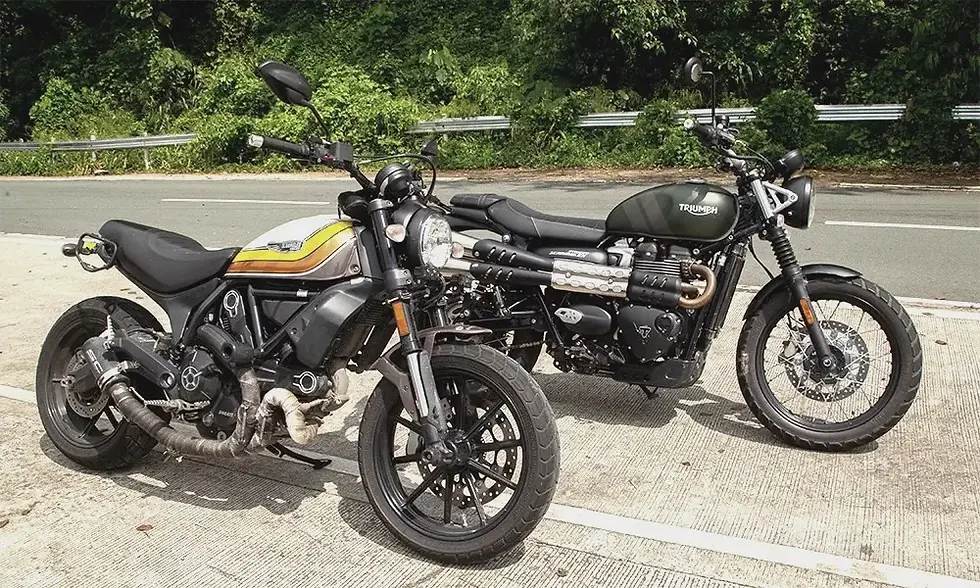
Precisely four brands on earth - four, out of over one thousand brands of motorcycles and mopeds currently available - can charge premium prices for inferior goods. Harley-Davidson, BMW, Triumph, and Ducati. That’s it. Just them. KTM did for a while until they slammed face-first into market reality in late 2024 and went bust.
You can only be “premium” if your intangibles match the perceived value inside the minds of carefully cultivated fans. This takes a very long time, real effort, and no amount of marketing bullshit will ever compensate for lack of authenticity.
Can-Am or Can’t-Am?
BRP has botched it this time. It happens, and every brand - including the Japanese - have made colossal mistakes at some point in this very challenging industry. The good news is humans are great at learning, and to those who don’t know, the corporate history of BRP (née Bombardier Industries) is one of resilience, fortitude, shrewd decisions and sometimes flashes of genius.

Bombardier went from a regional maker of recreational winter vehicles (snowmobiles) to acquiring aerospace and rail divisions that rivalled the world's best; they saved iconic American brands like LearJet, Johnson and Evinrude outboard engines, and ROTAX engines in Austria. They invented the modern snowmobile, sit-down personal watercraft, were among the pioneers of ultra clean burning two-stroke engine technology, and even made equipment for the Canadian Space Agency.

Here is the best part: since being spun off and taken public, BRP has made money hand over fist, survived the 2008 financial crisis without bailouts, and its stock has exploded. Today, BRP's market cap is double that of Harley-Davidson.
BRP screwed up the Origin and Pulse. As a Canadian, a motorcycle professional, a Can-Am enthusiast, and an electrification expert, this pains me. It was avoidable. But hindsight is 20/20, and I don’t possess inside knowledge about the program. What I do know is that the second attempt can be done, should be done, and can and should be successful and profitable.
It all depends on willpower. Will shareholders let the new CEO and leadership try again? And will BRP mine some of the 140 years of experience this dynamic industry has to share this time? Or will pride win the day, excusing this to “market forces” while Can-Am quietly slinks back to the forests and lakes?
on verra.
Ride safe, folks.
Sources: This article draws on NHTSA recall records, BRP documentation, US dealer research and Michael's own industry research. Key source material is available on request.
Editor's note: Michael writes from his own experience and perspective. The views expressed in this article are his personal views and do not necessarily reflect those of Buck City Biker.
For more motorcycle industry insights, Join Michael on his Substack.

Tired of scrolling? Subscribe to our newsletter. It's free, no spam, just an email on Friday.
Want more from BCB? Become a member.


