

Donut’s Latest VTT Test Targets the “Supercapacitor” Critics

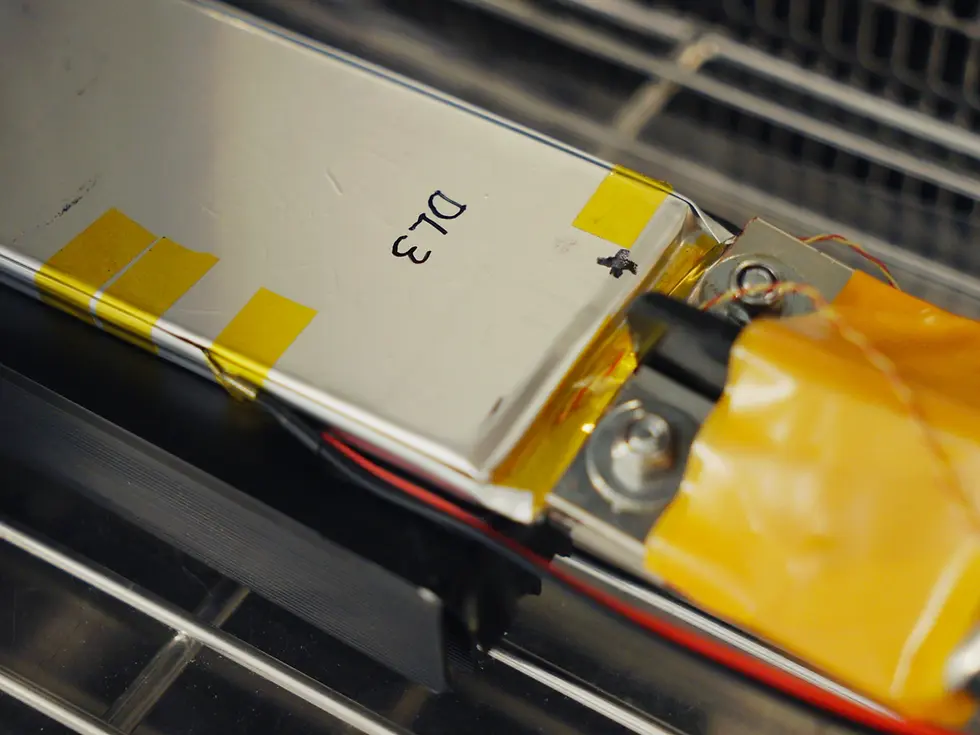
Donut has dropped the third video in its “I Donut Believe” validation series, and this time we've moved on from charging speed and temperature tolerance. It’s now 'self-discharge' that's under the microscope.
Basically, what happens when the battery just sits there doing nothing. Because one of the criticisms floating around the battery world is that Donut’s wild charge rates look suspiciously like supercapacitor behaviour.
Supercapacitors can dump and take power insanely fast, but they also bleed charge quickly when idle. Batteries don’t. So Donut asked the folks at VTT Technical Research Centre of Finland to run a simple but telling test.
Watch the Video
Key Takeaways from the VTT Self-Discharge Test
Simple test, big question. VTT charged the Donut solid-state cell, hooked it to lab monitoring equipment, and then left it alone.
No riding, no load. The cell wasn’t cycled or discharged. Voltage was logged every 10 seconds while the battery sat idle for 10 days.
Initial stabilisation drop. During the first hour the voltage fell from 3861 mV to 3722 mV, something VTT says is normal stabilisation behaviour after charging.
Then the curve flattened. After that early dip, the voltage held steady for the rest of the test window.
End result: after ten days the cell still retained 97.7% of its stored energy.
Why that matters. Supercapacitors, which some claim the Donut cell behaves like, typically lose charge far faster when idle.
What this suggests. The measured behaviour looks like a battery storing energy, not a capacitor bleeding it away.
Read the full technical report from VTT here
The BCB Take

This test doesn’t prove Donut has cracked the battery code, yet. But it does knock down one of the biggest internet theories, that the cell is basically a glorified supercapacitor.
That said, the real heavyweight claims still haven’t faced independent scrutiny:
400 Wh/kg energy density
100,000 cycle lifespan
Those are the numbers that would genuinely rewrite the rules for electric motorcycles. For now, Donut keeps stacking data points and drip-feeding us the results.
For now Donut is firmly holding the narrative. But these tests have us more curious than ever to see the rest of the results, and the moment they drop, we’ll make sure you hear about it.
Ride safe, folks.
Don't miss the next story. Subscribe to our newsletter. It's free, no spam, just an email on Fridays. Stay tuned on the latest electric motorcycle news with Buck City Biker.


