


Donut Battery: Did The e-Moto Game Just Get a Serious Upgrade?
- Buck City Biker

- Jan 5
- 4 min read
Updated: Jan 24

We live in a world where new battery tech gets announced almost weekly. Big OEMs promise solid-state by 2030, while everyone else throws around terms that all sound suspiciously similar — semi-solid, quasi-solid, LiFePO₄. Well, today Donut Lab dropped something that isn’t “coming soon.” It’s apparently here, real, and already powering production vehicles.
TL;DR? jump to the battery specs, or see it in the Verge TS Pro
Who are Donut Lab

Donut Lab hit the radar in 2025 with the launch of its now-famous donut motor — a hubless hub design riders will recognise from Verge Motorcycles' TS Pro. And that matters. Donut didn’t tease it for years or hide it behind concept bikes. They announced it when it was ready, already rolling out in production machines. They’re following the same playbook with their new battery.

Love it or hate it, the donut motor has forced a rethink of what an e-moto drivetrain can be. With a power-to-weight ratio that outmuscles anything else on the market. The design simplifies drivetrains, and opens doors well beyond motorcycles — cars, trucks, cranes, industrial kits, all fair game.
The Donut Battery Specs
Enough waffle — let’s get into the numbers of “the world’s first all-solid-state battery in a production vehicle,” according to Donut. This is what they're putting on the table:
All solid-state architecture
Energy density of 400Wh/kg — roughly double the range potential compared to today’s mainstream packs
Ultra-long lifespan — rated for up to 100,000 charge cycles (yes, that’s not a typo)
Zero fire risk
100% green chemistry — built from globally abundant materials — no rare earths and no lithium-ion
Cold-weather resilience — retaining over 99% capacity at -30°C
Durability — drain to 0, charge to 100, the pack still works fine
Charging — Donut are promising a cell level charge rate of 5 minutes, for the full lifecycle, without degradation.
And here’s the kicker: it’s cheaper than lithium-ion

On paper, that’s a spec sheet that doesn’t just meet the industry’s expectations — it completely laps them. Donut’s battery is supposedly already rolling out in production, starting with the updated Verge TS Pro. If you’ve got one on order, this pack is what’s turning up in the crate.
Now let’s dig into what those stats actually mean in the real world.
Why This Battery Changes the Game

All solid-state: Solid-state isn’t new, but actually shipping it at scale is. Dropping liquid electrolytes removes a host of compromises — thermal management, containment, fire risk, and long-term degradation. For e-motos, that means simpler architecture, fewer failure points, less weight, lower cost, and fewer things to go wrong when the bike gets ridden hard.
400Wh/kg energy density: This is a headline stat for riders. At roughly double the energy density of today’s lithium-ion packs, manufacturers could finally get real choices: keep the same weight and extend range, or keep the same range and shave kilos.

Up to 100,000 charge cycles: Most battery talk quietly ignores lifespan. With up to 100,000 cycles, these packs could outlive the bike or your kids, even under heavy use. For high-mileage riders, fleet operators, or anyone tired of long-term degradation, this could change the ownership game.
Zero fire risk: Battery fires aren’t common, but when they happen, they’re catastrophic. A solid-state pack that eliminates thermal runaway is a huge step forward. Riders get peace of mind; and manufacturers get fewer constraints. Expect this to quietly unlock bolder bike designs.

Green chemistry, no lithium-ion or rare earths: Using globally abundant materials cuts supply-chain risk, cost swings, and geopolitical bottlenecks — key if you want to scale production instead of trickle-feeding limited-run bikes. Fewer exotic elements also mean simpler recycling and less regulatory headache.

Cold-weather performance: Retaining over 99% capacity at -30°C is a huge claim. Any rider who’s faced winter range loss knows the difference this makes.
Cheaper than lithium-ion: This is the stat that ties it all together: safer chemistry — lower cost. That combination almost never happens. If Donut can deliver at scale — which they say they already are — it removes one of the last barriers to wider e-moto adoption. Riders win, plain and simple.
Verge TS Pro - Quick Charge and 600km
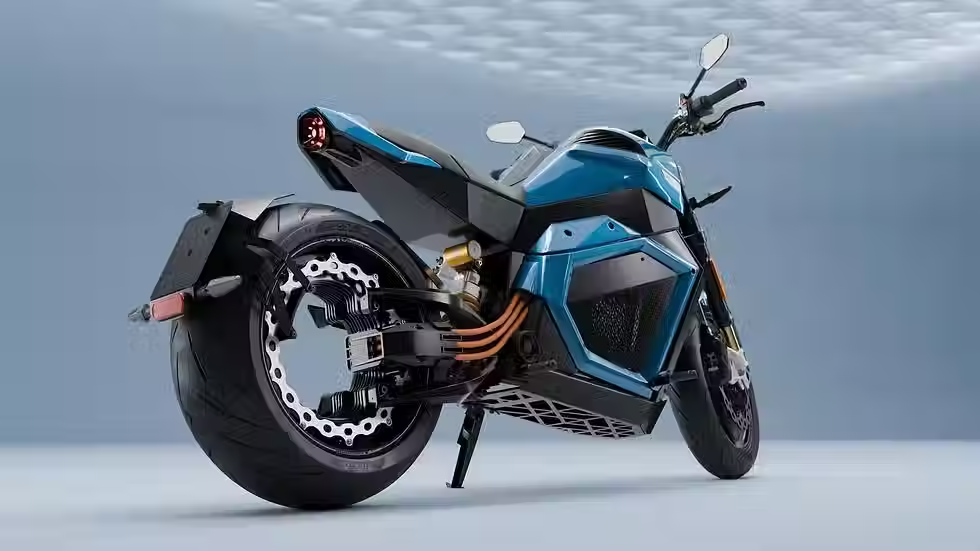
Verge’s latest TS Pro takes the next-generation concept seriously — over 100 improvements from its predecessor. The new Donut motor is 50% lighter while keeping the same 1,000 Nm of torque, and the dash board now sports two displays for a sharper, more connected riding experience.

Thanks to the Donut Battery, the TS Pro has officially become the world’s first solid-state production vehicle. Charging times have been slashed from 35 minutes to under 10, while range holds steady at 350 km (217 miles)
And for those who want more, Verge have just unveiled a long-range variant capable of up to 600 km (372 miles) of real-world riding. if you have a TS Pro on order and now want the long range upgrade, just give them a call, they'll sort it for you.
The BCB Verdict

The claim that this battery is already running in the latest Verge motorcycle matters. Verge has become Donut Lab’s real-world proof point. And this means we will see the reality of what this technology can offer in a matter of weeks. But this tech isn’t limited to two wheels — from vehicles to domestic storage to industrial applications, we could soon see Donut’s battery rolling out globally across sectors.
Could this battery make it into every e-moto? We'll have to see. It’s apparently not limited to Verge, and Donut Lab claim they have a production capacity of 60 million units globally.
For riders, the takeaway is simple. We’ve spent years being told the real breakthrough was five years away or stuck in “future roadmaps.” This is a big promise from a small operator in a sector that's invested millions to achieve the same goal, and it's already making the rest of the industry uncomfortable.
We can't wait to see how this pans out as the next TS Pros land in customers garages.
Ride safe, folks
Can't miss the next story? Subscribe to our newsletter. It's free, no spam, just an email on Fridays. Stay tuned on the latest electric motorcycle news with Buck City Biker.


