

How To Design an Electric Motorcycle, with Hugo Eccles
- Buck City Biker

- Dec 24, 2025
- 6 min read

Designing a motorcycle is easy if all you want is something that moves on tarmac. Designing one that makes sense, looks good, rides right, and doesn’t hide behind styling fluff? That’s harder. Hugo Eccles, from UNTLD MOTO, lives in that harder space.
We sat down with Eccles to talk design — not a “how-to” guide, but mindset, process, and why electric motorcycles force designers to show their work. What followed was less about sketchpads and more about stripping things back until there’s nowhere left to hide.
Who Is Hugo Eccles?

Hugo Eccles is one of those designers whose CV quietly looms large. Industrial design by training, vehicle design by obsession. His background includes senior design work at IDEO, Landor, Omnicom, and Ford before moving into motorcycle projects that put him on the radar of the two-wheel world — most notably his work with Ducati, with their advanced concept Hyper Scrambler project. Since then, Eccles has operated at the sharp end of consultancy, working across automotive, product, and brand design, while increasingly focusing on motorcycles — including electric platforms for Zero Motorcycles and Harley-Davidson LiveWire.

Born in Oxfordshire and now based in California, Eccles came up through industrial design. While some designers start with a silhouette and work inward, Eccles starts with structure, function, and constraint — and lets the form earn its place.
Motorcycles weren’t a late pivot. They’ve been there since childhood, from his father’s bikes to a family history steeped in engineering. His work has been featured by some of the most respected design magazines and legacy motorcycle media channels, reflecting a reputation that stretches beyond electric circles.
But Eccles is the first to admit he was probably more of a car guy than a motorcycle guy — which, paradoxically, may be why his bikes avoid motorcycle design clichés so effectively.
Hugo’s Philosophy: Less, but Better (and Nowhere to Hide)
“I consider myself a designer, not a stylist. Styling puts a shape over something. Design asks what that shape is actually doing.” Hugo Eccles
Eccles’ design philosophy is rooted in reduction. Strip the object down to what it must do, then make those remaining elements work harder.

Motorcycles suit that approach perfectly. Unlike cars, bikes don’t give you acres of bodywork to mask poor decisions. Where mechanics meets aesthetics, every bracket, fastener, and surface is part of the conversation.
“Motorcycles are interesting because there’s nowhere to hide. The mechanical parts are the aesthetic parts.” Hugo Eccles
Eccles is comfortable designing things where every surface is visible, judged, and touched. Electric motorcycles amplify that exposure.
One idea he keeps returning to is the difference between aesthetic beauty and intellectual beauty — a concept he traces back to Zen and the Art of Motorcycle Maintenance. A thing doesn’t have to be conventionally pretty to be beautiful. Sometimes it’s beautiful because it’s clever, resolved, or brutally efficient.
That’s why he draws a clear line between design and styling. Styling decorates. Design solves. If a part doesn’t contribute, it’s gone.
“If it’s not contributing, lose it. If one thing can do two jobs, that’s even better.” Hugo Eccles
The XP Zero: Finding Meaning in a Blank Sheet
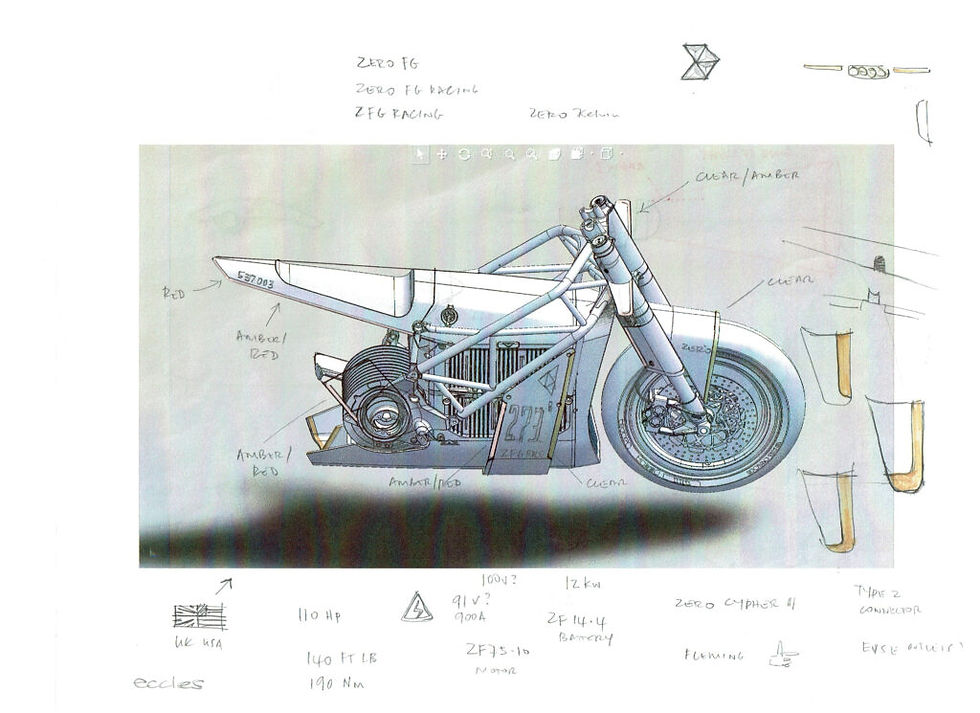
The XP Zero project forced all of this into the open.
Electric bikes remove many of the built-in constraints designers have relied on for decades. No fuel tank dictating volume. No exhaust routing. No engine layout defining character. Strip the bodywork off a Zero, and it still works — which is liberating but also deeply uncomfortable.
“The breakthrough came from riding the bike without bodywork — suddenly you realise you need those knee contact points to control it.” Hugo Eccles
Those knee contact points became the foundation of the design — functional human surfaces that earned their existence. From there, the idea expanded into a clear division between human surfaces (seat, pegs, bars, knee contact) and machine surfaces (cooling, aero, structure). Suddenly, the XP wasn’t wearing a shape. It was explaining itself.
“Those surfaces weren’t aesthetic. They were necessary. That’s when the whole idea came together.” Hugo Eccles

Even the seat followed that logic. What looks like a minimalist strip of leather wrapped around the rear fender is actually a carefully engineered saddle with dual-density foam, preserving the stock Zero ergonomics despite looking radically different. It’s a reminder that good design doesn’t announce itself — it just works.
There’s also a subtle historical layer to the XP. Rather than trying to look “futuristic,” Eccles treated it as a thought experiment: What if electric motorcycles had been the default since the 1890s? Same physics, different decisions. No need to cosplay petrol heritage or look like a prop from Battlestar Galactica.
“I had this idea of 'the pub test' — could I ride this there, park it outside, and not look ridiculous? Could you pull up outside a pub without wearing a silver jumpsuit? That mattered to me. It had to make sense on a real street.” Hugo Eccles
The result feels unfamiliar not because it’s trying to shock, but because it isn’t borrowing language it doesn’t need.
Where E-Moto Design Is Going — and Why Some Brands Suck

Electric motorcycles could have been a clean-sheet moment for design. In reality, a lot of brands panicked and reached straight for petrol-era comfort blankets: fake tanks, decorative bodywork, and shapes that exist purely to reassure riders that this strange new thing is still “a proper motorcycle.”
Hugo Eccles’ work highlights why that approach can feel increasingly hollow. Electric removes the usual constraints — no fuel volume or legacy powertrain anchoring the design — and that freedom exposes lazy decisions fast.
“Most people just mimic petrol. I don’t think that’s the right answer.” Hugo Eccles
The brands getting it right are starting from function, not nostalgia. They’re designing around human contact points, cooling, structure, and control — then letting the form emerge from that. The ones getting it wrong are still styling their way out of a problem that design should have solved.
“Electric is everything and nothing at the same time. Because it can do anything, you have to decide what you actually want it to be.” Hugo Eccles

From Eccles's point of view, electric motorcycle design isn’t about getting louder, weirder, or more futuristic. It’s about clarity, honesty, and finally being confident enough to stop pretending to be petrol-powered.
The next generation of electric bikes won’t win by copying the past. They’ll win by finally letting it go — and building motorcycles that make sense on their own terms.
What’s Next for Hugo?
Eccles is currently applying the same thinking to a LiveWire One project with Harley-Davidson’s electric arm.
“What if Harley had started electric in 1903? What decisions would they have made? We’re not trying to look futuristic — just asking what the bike would look like if petrol had never existed.” Hugo Eccles

Details are still under wraps, but the direction is familiar: resist mimicry, respect the powertrain for what it is, and don’t use bodywork as camouflage. The same questions apply — what are the essential human interfaces, what does the machine actually need to do, and how honest can the result be?
"The REV reimagines Harley-Davidson’s history as an electric alternate parallel reality, inspired by iconic racing machines of the 1920s, evolved for a century to incorporate state-of-the art technology, materials, and construction." UNTLD MOTO Website
If the XP was about defining a language, the LiveWire project looks like a chance to refine it on another production-scale platform — the constraints are different, but no less real.
No More Pretending - The BCB Take

Hugo Eccles isn’t interested in designing electric motorcycles that pretend to be something else. His work suggests the sector doesn’t need louder styling or nostalgic shortcuts — it needs clarity.
Electric bikes are already changing how motorcycles behave. Designers like Eccles are asking the harder follow-up question: What should they look like when they stop apologizing for it?
For riders who care less about cosplay and more about coherence, that’s a conversation worth having.
Ride safe, folks
Don't want to miss the next story? subscribe to our newsletter now. It's free, no spam, just an email on Fridays. Stay tuned on the latest electric motorcycle news with Buck City Biker.
Watch Hugo Talking about the XP Zero:
